
REVIEW · SARAJEVO OLD TOWN WALKING TOURS
Sarajevo genuine walking tour: Steps through history
Sarajevo history spills out on your feet. This private 2-hour walk threads through the Ottoman quarter, Baščaršija Square, and the sites tied to Archduke Franz Ferdinand, all with an English-speaking guide.
I especially like how the route stacks different faiths close together, so you see how Sarajevo grew as a shared urban space. I also like the private format, with one guide handling your questions at your pace, not a rushing crowd.
One drawback to consider is time. With about two hours, you’ll get meaningful stops, but you won’t have hours inside every building.
In This Review
- Key things you’ll notice on this walking tour
- Sarajevo’s religious crossroads make sense only on foot
- Starting at Sarajevo City Hall, with the Spite House legend
- Baščaršija Square and Sebilj Fountain, the city center at street level
- Old Serbian Orthodox Church, Byzantine details you can actually see
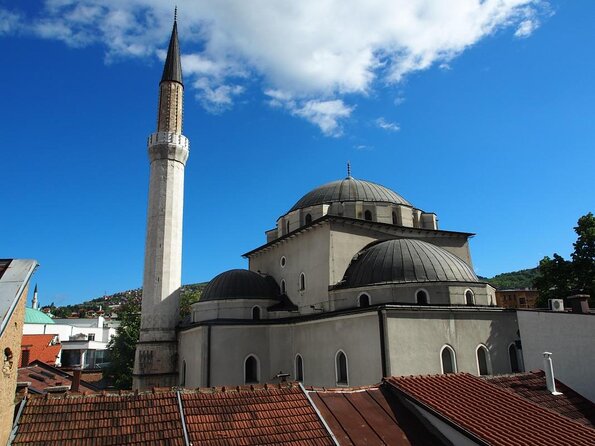
- Gazi Husrev-beg Mosque, Ottoman architecture with supporting institutions
- The Jewish quarter and Sephardic history, resilience in daily life
- Sacred Heart Cathedral and the unusual closeness of faiths
- Latin Bridge, the assassination that changed Europe
- Price and time, and why private works better here
- Getting the most from the guide, especially if you get Sanela or Amilia
- Who this tour is best for, and when it might not fit
- Should you book this Sarajevo genuine walking tour?
- FAQ
- How long is the Sarajevo genuine walking tour?
- What does the tour cost?
- Is this tour private?
- Where do we meet, and where does the tour end?
- What language is the tour offered in, and do I get a mobile ticket?
- Can I cancel for a full refund?
Key things you’ll notice on this walking tour
- A private guide for just your group
- Ottoman quarter + Baščaršija Square in the first stretch
- Churches, mosques, and the Jewish quarter on one compact route
- Latin Bridge, where Franz Ferdinand was assassinated
- Admissions listed as free for the planned stops
- English tour with a mobile ticket
Different walks through the Sarajevo old town
- Sarajevo: 2 Hours Old Town Walking Tour With Local Guide
★ 5.0 · 505 reviews - Sarajevo Grand Walking Tour
★ 5.0 · 232 reviews - Sarajevo Grand Tour: Old Town, War Tunnel, Olympic Sites & More
★ 5.0 · 73 reviews - Delicious Sarajevo: Eat, Walk & Discover City Tour
★ 4.5 · 37 reviews
Sarajevo’s religious crossroads make sense only on foot
Sarajevo can feel like a postcard, then reality kicks in fast: multiple religions, multiple empires, and multiple languages all left visible marks. What makes this tour work is that you’re not only looking at landmarks, you’re walking between them, so the city’s closeness becomes the lesson.
I like that the plan covers several major religious sites in a short walk, including the Islamic heart of Baščaršija and the Christian churches tucked nearby. You also get a moment at the Latin Bridge, which turns the day from architecture appreciation into history you can point to.
If you want a morning or afternoon that feels organized, but still flexible, this is a solid pick. It’s around two hours, and it’s designed to fit comfortably into a full sightseeing day.
Starting at Sarajevo City Hall, with the Spite House legend
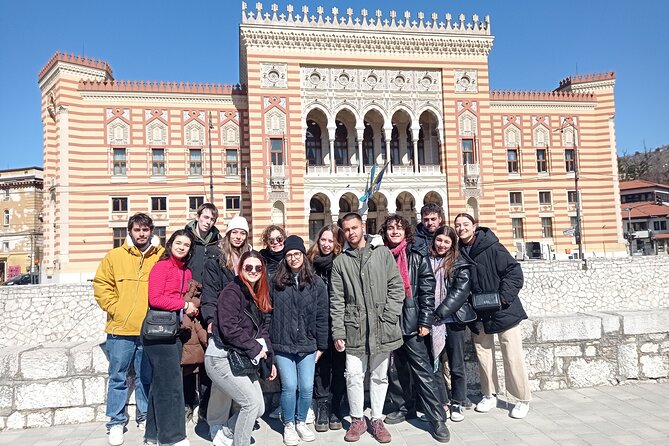
You begin at Sarajevo City Hall on Obala Kulina Bana. This building is hard to miss, and it’s one reason the walk starts here. The architecture is described as Pseudo-Moorish, which helps set the tone: Sarajevo’s story includes Ottoman influence, European ambition, and local adaptation.
What I find useful is that the guide doesn’t just gesture at the facade. You get context as you stand there, plus the legend of the Spite house. Even if legends aren’t your thing, stories like this are a quick way to understand how neighborhoods talk about each other over time.
Tip for your first minutes: listen closely right away. Early on, the guide sets up the city’s timeline, and it makes later stops click.
Baščaršija Square and Sebilj Fountain, the city center at street level
Next you head into Baščaršija Square and pause at the Sebilj Fountain. This is one of those places that feels like a meeting point even if you’re visiting for the first time. The fountain is treated here as a symbol of Sarajevo’s cultural heritage, so it’s not just a photo stop.
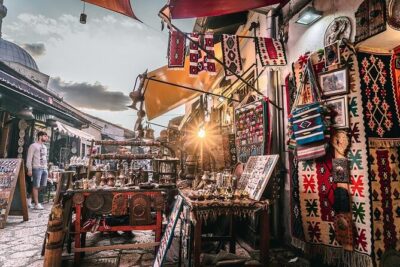
You’ll have time to walk the square at a human pace, and that matters. Baščaršija is where the city’s older character shows up in everyday form: small lanes, storefront rhythm, and a sense that people have always moved through here.
A practical note: since the tour is walking-based and concentrated, you’ll want comfortable shoes. This is the kind of route that rewards steady feet more than fast ones.
Old Serbian Orthodox Church, Byzantine details you can actually see
From the square, you move to the Old Serbian Orthodox Church, dedicated to Archangels Michael and Gabriel. The guide focuses on its place among the city’s older houses of worship, and you’re pointed toward the Byzantine architecture that gives it its distinct feel.
This stop is short, about 10 minutes, so the value is in direction. You’re not left wandering. You’re guided to what to notice, and that keeps you from missing the whole point while rushing your camera.
If you like architecture, you’ll enjoy how the guide ties the building to the broader multi-faith story of Sarajevo. If you don’t, you’ll still get something useful: a clearer sense of what people built and believed, and how those choices shaped the city’s layout.
Other walks we have put boots to

Gazi Husrev-beg Mosque, Ottoman architecture with supporting institutions
The tour then heads into the heart of Baščaršija for Gazi Husrev-beg Mosque. Here the focus is on Ottoman architecture and the mosque complex as a whole.
What’s especially helpful is that you don’t only look at the main prayer space. The complex includes a madrasa, a library, and a clock tower, which turns the stop into something bigger than a single building. The guide frames it as an ongoing spiritual and educational legacy, not just an object behind glass.
This is one of the places where a private guide makes a noticeable difference. You get space to ask your questions and get straight answers, and the route keeps moving so you don’t spend half your day waiting.
Also, the way the stops are arranged means you can see contrasts without long travel time. Mosque, fountain, Orthodox church, then onward, all in a compact radius.
The Jewish quarter and Sephardic history, resilience in daily life
After the mosque area, you visit the Jewish Museum of Bosnia and Herzegovina in the Jewish quarter. The tour frames this as a story of resilience and heritage of Sephardic Jews in Bosnia and Herzegovina.
What I like about this inclusion is that it widens your understanding of Sarajevo beyond the most obvious two or three narratives. You’re getting a third layer of the city, one that’s less likely to show up if you only do a standard landmark loop.
Because the stop is brief, plan to treat it as a guided orientation. You’re likely to leave with a few specific threads to follow later, especially about community survival and cultural continuity.
If you enjoy museum time but don’t want to commit to a half-day ticketed visit, this works. It’s history without turning your day into a lecture.
Sacred Heart Cathedral and the unusual closeness of faiths
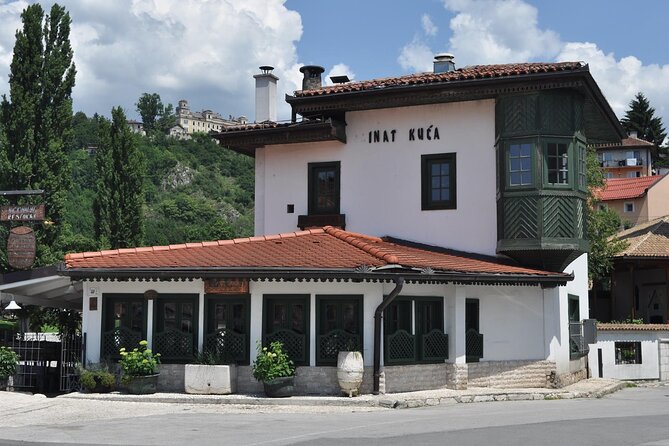
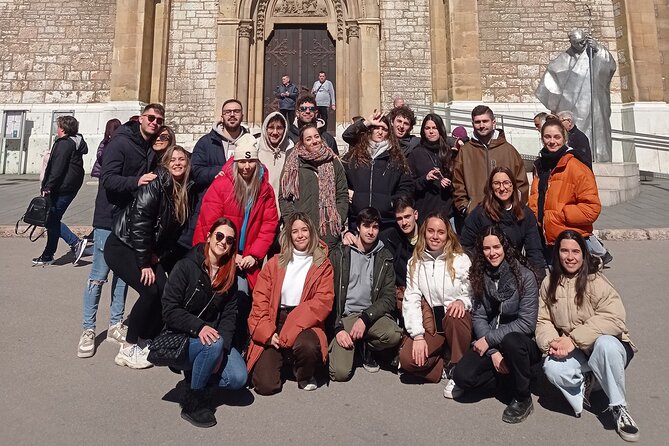
Next comes the Cathedral of the Sacred Heart of Jesus in Sarajevo. This stop is framed around architectural beauty and endurance through conflict, with the cathedral presented as a symbol of resilience.
Here’s the moment that often makes Sarajevo click for first-time visitors: after you see the major multi-confessional religious objects, you understand how close they are. The tour points out that they are about 100 square meters apart, which is not a vague idea. You literally see the proximity.
That small distance changes how you interpret the city. Instead of imagining separate zones for separate faiths, you see the overlap in streets, sightlines, and everyday movement.
This stop is also useful if you care about modern Sarajevo identity. It’s not only about empires and dates. It’s about how communities share space and rebuild their meaning after hard times.
Latin Bridge, the assassination that changed Europe
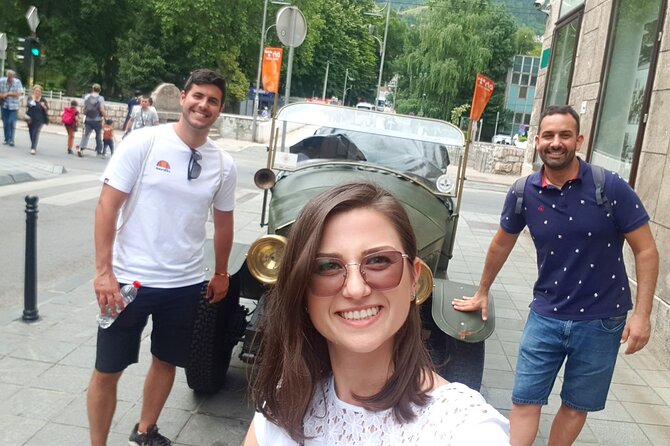
You end at the Latin Bridge, next to where Archduke Franz Ferdinand was assassinated, an event tied to the beginning of World War I. This is a heavy moment, but the tour keeps it grounded by staying at the location itself.
What makes this ending powerful is that you’ve already walked through the city’s religious and cultural mix. So when the guide shifts into the story of 1914 and the chain of events that followed, the city feels less like a backdrop. It feels like a real place where history happened.
The stop is about 20 minutes, which is a good length for the kind of explanation you need at the exact spot. You’re not rushed through names, and you’re not left with only a plaque and your imagination.
If you’re the type who likes to understand cause and effect, this is the part where you’ll likely connect the dots most.
Price and time, and why private works better here
This tour costs $27.61 per person and runs about two hours. That’s fair for a private walking experience because you’re not paying only for movement, you’re paying for the guide time and for a route that covers multiple major stops efficiently.
A few value points that matter:
- Admission is listed as free for the planned stops, so you are mainly paying for guidance and time.
- You get a private setup, meaning your questions do not get swallowed by a large group.
- You don’t need to fight for attention while you’re standing in tight historic areas.
You’ll also have a mobile ticket, and it’s in English. The meeting point is Sarajevo City Hall (Brodac 1), and the activity ends back at the same spot.
From a practical standpoint, two hours is a sweet spot. Long enough to cover the major beats, short enough to keep your energy up, especially if you’ve got other plans in Sarajevo.
Getting the most from the guide, especially if you get Sanela or Amilia
The guides behind the experience have a strong reputation for keeping things moving and answering questions clearly. Two names show up in the guide praise: Sanela and Amilia. In plain terms, you can expect the conversation to stay practical, not vague, and the guide to handle follow-up questions without getting flustered.
You’ll get the best result if you come with at least one question in mind. Examples that fit this route:
- How did Ottoman influence shape the city center?
- Why are these religious sites so close together?
- What do the Latin Bridge sites mean beyond the headline event?
Even if you don’t come with questions, the guide should steer you toward what to notice at each stop. That matters because some details in older Sarajevo are easy to miss if you only rely on your phone camera.
Who this tour is best for, and when it might not fit
This walking tour is a good fit if you want:
- A compact route through Ottoman Baščaršija, multiple faith sites, and Latin Bridge
- An English-speaking guide who can explain what you’re seeing
- A private experience that feels more like a conversation than a checklist
It may be less ideal if:
- You need more time inside buildings. The planned stops are short, so you’re mostly there to learn what matters and move on.
- You prefer long museum-style visits rather than quick, well-explained waypoints.
Also, because it’s a walking tour in a historic center, plan for that general reality: you’ll be on your feet and moving between sites.
Should you book this Sarajevo genuine walking tour?
If you’re spending a limited amount of time in Sarajevo and you want the city’s identity in one clear route, I’d book it. The value is in the way you see how different communities and empires left marks right next to each other, then you finish at a location that connects Sarajevo to a turning point in modern European history.
Book it especially if you like guided context more than wandering. City Hall, Baščaršija, mosque architecture, church sites, Jewish heritage, and Latin Bridge are all big themes. This tour stitches them together into a story you can walk through, not just read about later.
If, however, you’re in Sarajevo specifically for deep study of one topic, you might want a themed day focused on that single angle. This one is broad on purpose. It gives you the bigger picture fast.
That balance is why it works for so many first visits.
FAQ
How long is the Sarajevo genuine walking tour?
It lasts about 2 hours.
What does the tour cost?
The price is $27.61 per person.
Is this tour private?
Yes, it is a private tour, and only your group participates.
Where do we meet, and where does the tour end?
The meeting point is Sarajevo City Hall, Brodac 1, Sarajevo 71000, Bosnia and Herzegovina, and the tour ends back at the meeting point.
What language is the tour offered in, and do I get a mobile ticket?
The tour is offered in English, and you receive a mobile ticket.
Can I cancel for a full refund?
Yes. You can cancel up to 24 hours in advance for a full refund. If you cancel less than 24 hours before the start time, the amount paid is not refunded.
More Tours Across Bosnia
The Full Bosnia Review Shelf
Walking Sarajevo, Other Routes
Recently added to the Bosnia and Herzegovina shelf
- Walking Tour in Sarajevo★ 5.0 · 3 reviews
- Travnik, Jajce, Pliva Lakes & Mills –Medieval & Ottoman Bosnia Full Day Tour★ 5.0 · 3 reviews
- Tour of Herzegovina – From Sarajevo★ 5.0 · 3 reviews
- The Siege of Sarajevo Tour★ 5.0 · 3 reviews
- Srebrenica Genocide Tour from Sarajevo★ 4.5 · 3 reviews
- Sarajevo to Zagreb: One-Way Tour via Jajce, Travnik, Pliva Lake and Watermills★ 5.0 · 3 reviews
Sarajevo Old Town Walking Tours, compared.
 ★ 5.0Sarajevo: 2 Hours Old Town Walking Tour With Local GuideFrom $14505 reviews
 ★ 5.0Sarajevo Grand Walking TourFrom $20232 reviews
 ★ 5.0Sarajevo Essential Full Walking TourFrom $18198 reviews
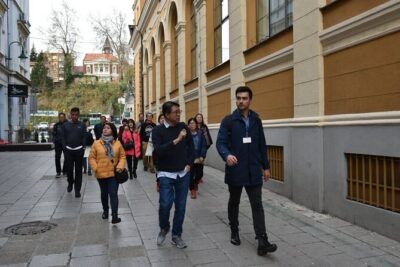 ★ 5.0Sarajevo Grand Tour: Old Town, War Tunnel, Olympic Sites & MoreFrom $4773 reviews
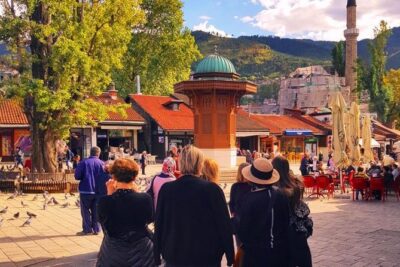 ★ 4.5Delicious Sarajevo: Eat, Walk & Discover City TourFrom $6837 reviews
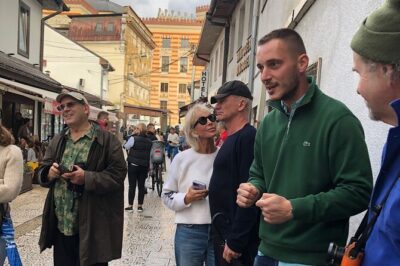 ★ 5.0PROFESSIONAL SARAJEVO WALKING TOUR – With guide who guided STING!From $3129 reviews
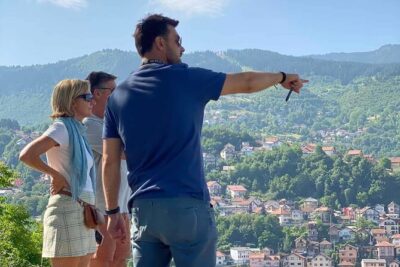 ★ 5.0Sarajevo Full Day Tour: History, Culture, Nature, War & OlympicsFrom $11427 reviews
 ★ 4.5Sensational Sarajevo Sunset Walking TourFrom $1726 reviews
Browse the lists this tour appears in