
REVIEW · TRAVNIK, JAJCE & CENTRAL BOSNIA
Bosnian Kingdom Capitals: Travnik & Jajce Tour from Sarajevo
Bosnia packs a lot into one route. This full-day tour links two former kingdom capitals, then layers in Ottoman-era landmarks, museum stops, Roman archaeology, and nature around the Pliva lakes.
I like the range of eras you hit in a single day, from Ottoman mosques to the Roman Mithras Temple. I also like that you get built-in time for the best sights, with Pliva Waterfall and the Mlincici watermills coming right after the heavier history stops.
One thing to consider: it is a long day, about 10 to 12 hours, and many stops are short. So if you want a slow pace, extra café time, and lots of wandering, this might feel a bit time-pressed.
In This Review
- Key highlights worth aiming for
- Why this route works: two capitals plus Pliva water
- Price and logistics: what $150.10 gets you
- Travnik start: Plava Voda and the Ottoman-era tone
- Tvrdava Stari grad: Old Town fortress views without the fantasy
- Šarena Džamija and two more Ottoman landmarks
- Ivo Andrić and local museums: quick stops with real names
- Catholic heritage stop: Church of St. John the Baptist
- Jajce begins: catacombs and a fortress on top of the kingdom
- AVNOJ Museum and the Mithra Temple: two time machines in one afternoon
- Pliva Waterfall and Mlincici watermills: where the day slows down
- Dinner break in Jajce, then back to Sarajevo
- The practical value for different travel styles
- Should you book Bosnian Kingdom Capitals: Travnik and Jajce from Sarajevo?
- FAQ
- Where does the tour start and end?
- How long is the tour?
- Is pickup offered?
- What is included in the tour price?
- What meals are included?
- Is this tour open to solo travelers or groups?
Key highlights worth aiming for
- Travnik Ottoman atmosphere, including Šarena Džamija and the fortress views from Tvrdava Stari grad
- Ivo Andrić birthplace museum, a quick but meaningful literary stop in Travnik
- Jajce under your feet, with the Catacomb of Jajce and then up to the Fortress of Jajce
- AVNOJ Museum in Jajce, tied to the 1943 founding moments of Yugoslavia
- Mithra Temple, a 3rd-century Roman site that’s one of the most preserved Mithraic icons in the Balkans
- Pliva Waterfall and Mlincici, where the day shifts from monuments to water-powered everyday history
More of central Bosnia: Travnik, Jajce, Visoko
- From Sarajevo: Travnik, Jajce, Pliva Lakes & Watermills Tour
★ 5.0 · 213 reviews - Jajce, Travnik, Pliva lake and Watermills Tour
★ 5.0 · 104 reviews - Travnik, Jajce & Pliva Lakes Day Tour From Sarajevo (fees Incl.)
★ 5.0 · 50 reviews - Sarajevo: Day Trip to Bosnian Castles Vranduk, Tešanj & Srebrenik
★ 5.0 · 21 reviews
Why this route works: two capitals plus Pliva water
This tour is built around a simple idea that pays off: Travnik and Jajce feel like two different chapters of the same story. Travnik gives you Ottoman-era architecture and local identity through landmarks and short museum visits. Jajce swings the focus to a kingdom fortress, underground tunnels, and then Roman and Yugoslav-era layers.
The payoff is that you do not spend the whole day staring at one type of attraction. You move from mosques and tombs to a Nobel Prize author’s childhood home, then switch to catacombs and a fortress, and finally end with the water area around the Pliva lakes.
It is also practical. You start in Sarajevo at Sarajevo City Hall (Brodac 1), and you get transportation in an air-conditioned vehicle with WiFi on board. That matters, because the day is long, and you will want energy for the hilltop views and the underground stop.
Price and logistics: what $150.10 gets you
At $150.10 per person, you are paying for a full-day structure: transport, guided interpretation, and included admissions for many key stops. The tour also provides bottled water and a snack (a chocolate bar or chips), so you are less likely to get caught short between long sightseeing blocks.
You should also know what is not covered. Lunch and dinner are not included, so budget for a meal stop on your own during the Jajce break (45 minutes to 1 hour). Alcoholic beverages also are not included.
Duration is listed as 10 to 12 hours (about), and the tour notes that remaining hours are mostly travel. That means your “active time” is spread out across 14 stops, with only a handful lasting around 30 minutes. In other words, you are buying convenience and variety, not deep, slow study.
The tour is also described as private for your group. In one real review, the operator organized a one-person version and paired the guest with local guides in Travnik and Jajce, coordinated by Muhmmnad. That suggests the company is willing to adjust when numbers are small.
Travnik start: Plava Voda and the Ottoman-era tone
Your Travnik side begins with Plava Voda, a national monument setting tied to Ottoman and local religious heritage. The stop covers multiple points in a compact area, including the Derventa cemetery, the Lutvina Kahva café, and the monumental tomb of mufti Mehmed Efendi and his wife Ajiša.
Admission is free, and you typically get about 20 minutes here. That timing works well because Plava Voda is meaningful, but it is not a sprawling complex you need hours to absorb. You will get the key atmosphere and the important names, then move on before the day gets too long.
A small consideration: since this is a cemetery and monument environment, dress with respect. Also, bring a light layer if weather turns, because you will be outdoors for parts of the day and visibility matters for photography.
Tvrdava Stari grad: Old Town fortress views without the fantasy
Next comes Tvrdava Stari grad (Travnik’s Old Town fortress). You get about 35 minutes, with admission included. Expect a hilltop fortress layout, including well-preserved walls and towers, plus winding streets.
This is the kind of stop that helps you understand the town. When you are up there, Travnik’s Ottoman-era placement makes more sense. You also get panoramic views, which is where most people feel the hour was worth it.
Practical tip: wear shoes with grip. Fortress paths can be uneven, and you will be doing photos and short walks in multiple sites across the day. If you like crisp photos, this is a good stop to prioritize, because the views are a natural “memory anchor” for the day.
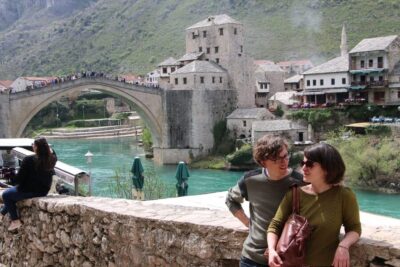
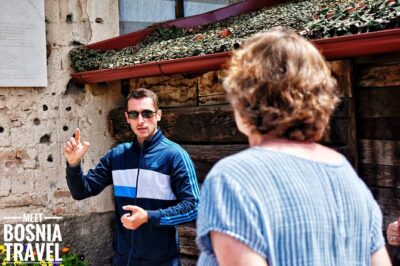
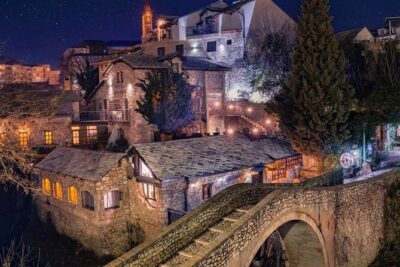

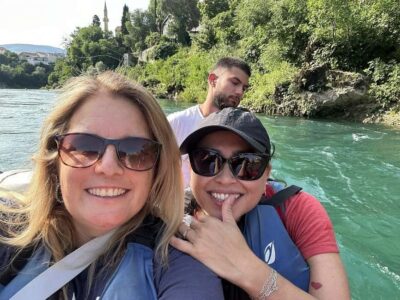
Šarena Džamija and two more Ottoman landmarks
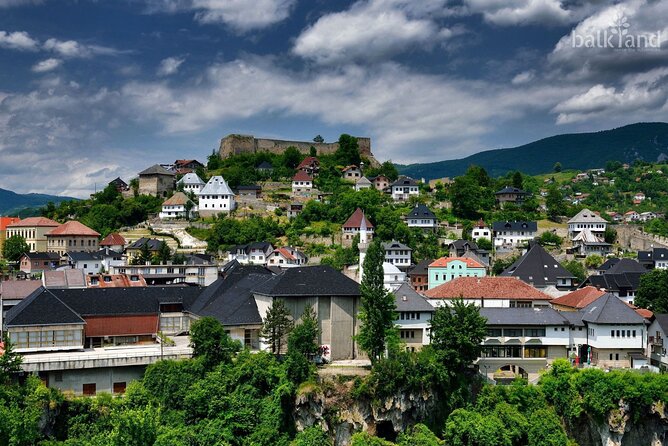
In Travnik, you also get time for a set of Ottoman-era religious landmarks that do not all look the same.
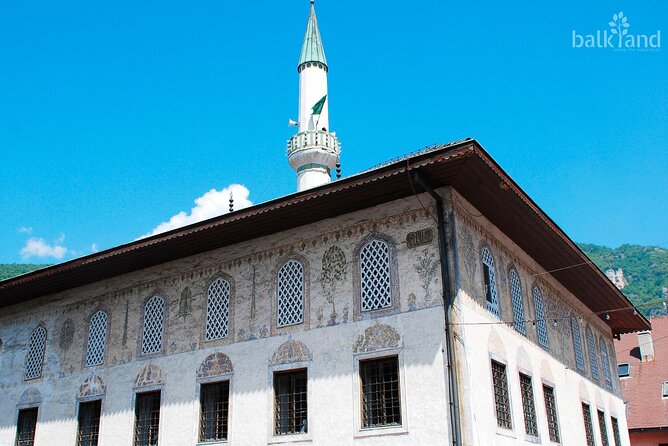
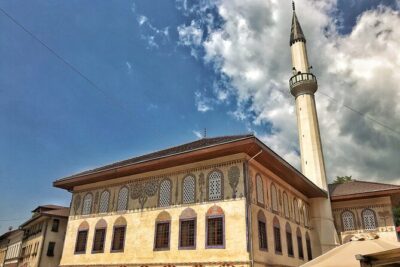
First is Sařena Džamija (Šarena Džamija), built in the 16th century during Ottoman rule. You get about 20 minutes, and admission is included. The focus here is the architecture and ornamentation. It is not only about “seeing a mosque,” it is about noticing how decoration and design communicate status and identity.
Then you move through two more shorter stops:
- Turbe, described as a vizier’s grave in an Ottoman-style mausoleum. About 10 minutes, free.
- Hadži Ali-Begova dzamija, an Ottoman-style mosque. About 10 minutes, free.
These two fit together because they give you the emotional shift from public worship space to commemorative space. You get architecture plus context, without needing museum tickets or long detours.
If you are photo-focused, keep an eye on lighting. Many of these interiors depend on opening hours and light, and time is limited. If you care most about details, aim to arrive early in the stop window, not at the end.
Ivo Andrić and local museums: quick stops with real names
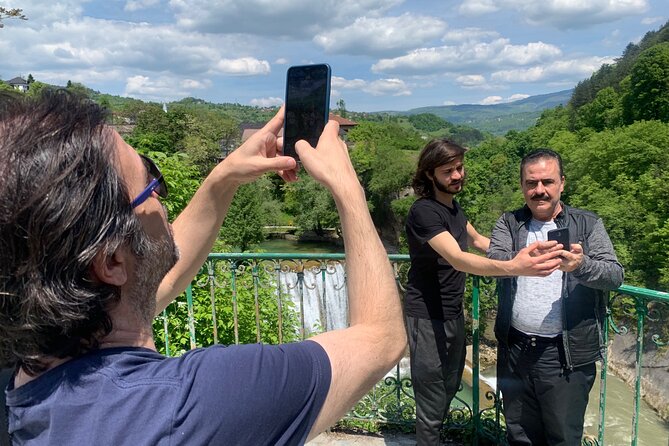
Travnik also gives you a literary and cultural pause. The stop Museum Birth House of Nobel Prize winner Ivo Andrić lasts about 15 minutes, admission included. The museum is a reconstructed birthplace opened in 1974. It sits as an annex to the Regional Museum of Travnik, and it has a permanent exhibition on his life and works.
This is a useful stop if you want more than scenery. Andrić is one of the big cultural names in the region, and even a short visit gives you a sharper sense of why this part of Bosnia mattered to authors and writers.
You also get Zavičajni muzej Travnik, about 10 minutes, admission included. The museum dates to 1950, with earlier collections housed in various buildings. Since 1972, it has been in a building constructed in 1928 for medical and health purposes, funded by the Rockefeller Foundation, with the permanent exhibition opened for visitors in 1975.
Yes, that is a lot of dates for one stop. But that is exactly the point. You are seeing how Travnik’s institutions evolved over time, not just how it looked in one era.
A practical note: museum time is short. So if you love museums, treat this as orientation and highlight-gathering, not as a full reading experience.
Catholic heritage stop: Church of St. John the Baptist
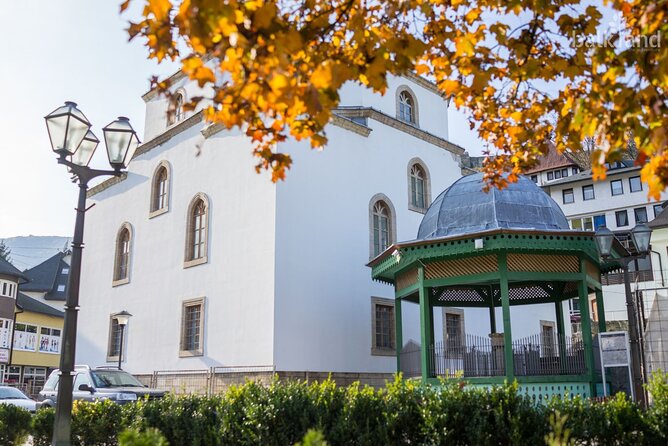
Another contrast stop is Katolička crkva Svetog Ivana Krstitelja (Church of St. John the Baptist). You get about 10 minutes, admission included.
It is described as mid-19th century Catholic worship. The interior includes religious artwork and a sacred altar. For many visitors, this church stop is one of the best “human scale” interruptions, because it shows that Travnik’s identity is not only Ottoman. There are layers, and you can feel them in places of worship.
Consideration: like other indoor sites, photos and time depend on local conditions. Keep your pace steady, and do not plan on “every angle” photos inside. The guide focus and time limits are part of the design of the day.
Jajce begins: catacombs and a fortress on top of the kingdom
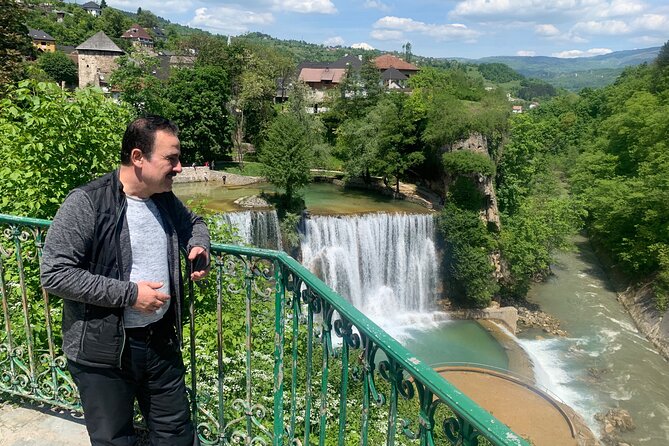
After Travnik, you shift to Jajce, another former capital with a dramatic setting. You first hit the Catacomb of Jajce, about 30 minutes, admission included.
This is an underground tunnel system built in medieval times. The best way to think about it is not as a horror maze, but as a historical site that uses space below ground. Because it is underground, you might want to keep expectations flexible for lighting and comfort. This is where a hat or sunglasses might be useful for the walk in, but you will likely stay attentive and follow the guide inside.
Then it is up to the Fortress of Jajce, about 30 minutes, admission included. The fortress is significant because it connects to the Bosnian kingdom period. It is described as the residence of the last two kings, and beneath it you can find the Coronation Church of St. Mary, where the final Bosnian king was crowned.
The views are part of the experience. The fortress sits on a hill, so you will be looking out over the town and surroundings. If you like history, this stop makes the landform feel important. If you like photos, it is one of the day’s easiest “I can see why this mattered” moments.
AVNOJ Museum and the Mithra Temple: two time machines in one afternoon
Jajce doesn’t stop at medieval walls. It turns into a timeline.
The AVNOJ Museum is about 20 minutes, admission included. The museum is connected to the founding moments of Yugoslavia, specifically the second session of AVNOJ in 1943. You’ll see artifacts and original items tied to decisions that shaped the Republic of Yugoslavia, with a framing that connects those choices to later independent countries in the Western Balkans.
This stop is great for understanding why people still talk about the region’s modern history, not only the distant past. It is also a reminder that Bosnia’s story is not one long costume party. It is politics, ideas, and change.
After that you visit the Temple of Mithras, about 20 minutes, admission included. This is Roman, built in the 3rd century AD by Roman soldiers. It is dedicated to the Indo-Iranian god Mithra, and the site is described as one of the best-preserved Mithraic icons in the Balkans.
If you are wondering how often you get Roman archaeology in a Balkan trip, the answer is not always. Here, you do. That makes it a standout value for people who want variety without adding extra days.
Pliva Waterfall and Mlincici watermills: where the day slows down
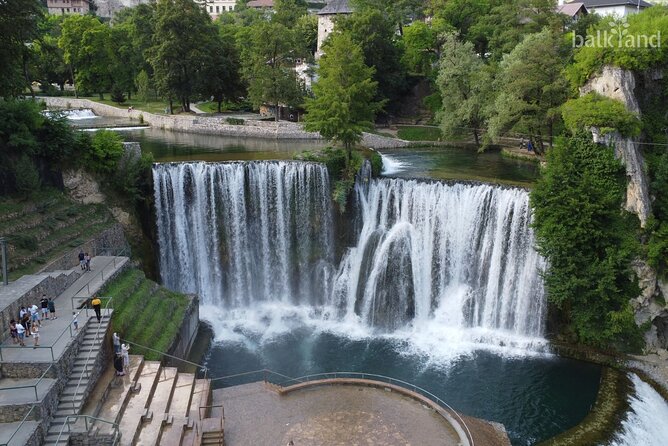
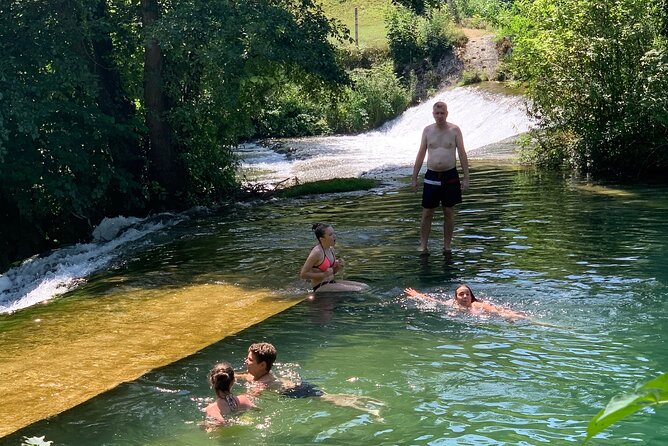
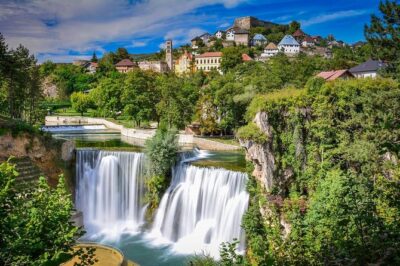
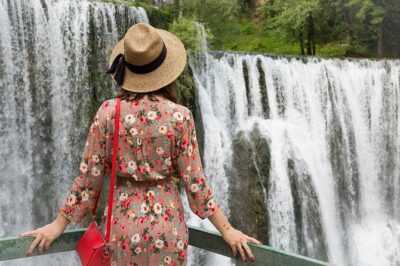
Then comes the natural reset: Pliva Waterfall, about 30 minutes, admission included. The description focuses on crystal clear waters cascading over moss-covered rocks, plus natural pools where you can take a refreshing dip. It is also a place for photos, and the sound of water helps reset your brain after catacombs and fortress stairs.
If you want to swim, bring swimwear and something to keep your phone safe. Even if you do not swim, plan to get damp feet depending on the path.
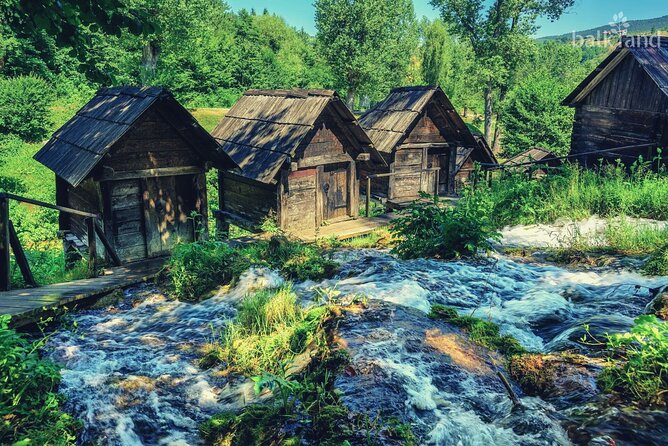
Next is Mlincici, the watermills area in Jajce. The stop is described after dinner break, and it focuses on the historical wooden watermills powered by the flow of the Pliva River. The mills ground grains into flour and supported the local community for centuries, flourishing during the Ottoman period.
This is an excellent “everyday history” stop. It is not only about royal decisions and religious architecture. It is about how people ate and worked, using the river as their engine.
Dinner break in Jajce, then back to Sarajevo
You get a dinner break in Jajce of about 45 minutes to 1 hour. Meals are not included, so use this time to eat what you like and pace yourself for the drive back.
After dinner, you start the return trip to Sarajevo, which takes about 2.5 hours. That means you will likely end the day tired, but also satisfied, because the route ends with a “soft landing” at the water and mills rather than ending right in another heavy indoor museum.
A practical tip: if you get car sick easily, mention it to yourself early. The day is long, and you are on the road after a full schedule.
The practical value for different travel styles
This tour fits best if you want:
- A structured full-day route with transport handled
- A mix of Ottoman, medieval, Roman, and modern-era themes
- Short museum visits that add context, without demanding a second day
It may not fit if you want:
- Lots of free time in every town square
- Deep, slow reading in museums
- A relaxed day focused only on nature
The best strategy is to treat the day like a “high signal sampler.” You will get names, places, and enough architecture to keep you curious for a return visit someday.
Should you book Bosnian Kingdom Capitals: Travnik and Jajce from Sarajevo?
If you are limited on time in Sarajevo, I think this is a strong choice. The value comes from how efficiently it combines multiple top sites around Travnik and Jajce, plus real included admissions, transport, and basic nourishment (water and a snack). For a single day, it is a lot of momentum in a good way.
I would book it if:
- You like variety, not just one theme
- You want Ottoman landmarks and fortress views without planning a multi-stop itinerary yourself
- You are okay with shorter visits at many sites
I would think twice if:
- You hate long days and prefer slower travel
- You want lunch and dinner handled for you
- You plan to skip most walking and indoor sights, since the itinerary is designed around getting to many places quickly
If you do book, pack comfy shoes and plan your meal stop in Jajce. Also, keep your phone charged. You will want photos at the fortress views, Pliva Waterfall, and the watermills.
FAQ
Where does the tour start and end?
It starts at Sarajevo City Hall (Brodac 1, Sarajevo 71000) and ends back at the same meeting point.
How long is the tour?
The duration is listed as 10 to 12 hours (approx.), and you should expect that some of the time is spent traveling.
Is pickup offered?
Pickup is offered, and you can start from the Sarajevo City Hall meeting point.
What is included in the tour price?
Included items are bottled water, snacks (chocolate bar or chips), all fees and taxes, air-conditioned vehicle, and WiFi on board. Many stop admissions are also marked as included in the itinerary.
What meals are included?
Lunch and dinner are not included. The tour includes a dinner break in Jajce of 45 minutes to 1 hour, so you will need to pay for your own meal.
Is this tour open to solo travelers or groups?
This is described as a private tour/activity, meaning only your group participates. The tour also notes that most travelers can participate.
More Tours Across Bosnia
The Full Bosnia Review Shelf
Central Bosnia, Beyond Travnik and Jajce
Recently added to the Bosnia and Herzegovina shelf
- Walking Tour in Sarajevo★ 5.0 · 3 reviews
- Travnik, Jajce, Pliva Lakes & Mills –Medieval & Ottoman Bosnia Full Day Tour★ 5.0 · 3 reviews
- Tour of Herzegovina – From Sarajevo★ 5.0 · 3 reviews
- The Siege of Sarajevo Tour★ 5.0 · 3 reviews
- Srebrenica Genocide Tour from Sarajevo★ 4.5 · 3 reviews
- Sarajevo to Zagreb: One-Way Tour via Jajce, Travnik, Pliva Lake and Watermills★ 5.0 · 3 reviews
Travnik, Jajce & Central Bosnia, compared.
 ★ 5.0Jajce, Travnik and Pliva watermills – Day Tour from SarajevoFrom $95295 reviews
 ★ 5.0From Sarajevo: Travnik, Jajce, Pliva Lakes & Watermills TourFrom $84213 reviews
 ★ 5.0Jajce, Travnik, Pliva lake and Watermills TourFrom $84104 reviews
 ★ 5.0Travnik, Jajce & Pliva Lakes Day Tour From Sarajevo (fees Incl.)From $9650 reviews
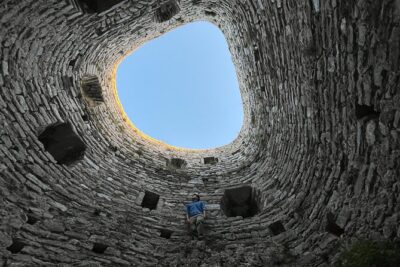 ★ 5.0Sarajevo: Day Trip to Bosnian Castles Vranduk, Tešanj & SrebrenikFrom $14921 reviews
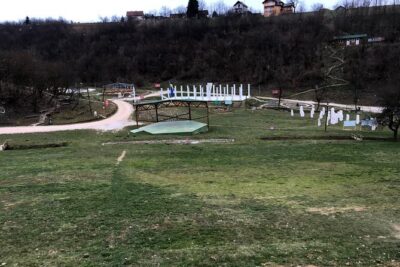 ★ 5.0From Sarajevo: Visoko And Bosnian Pyramid MisteryFrom $5818 reviews
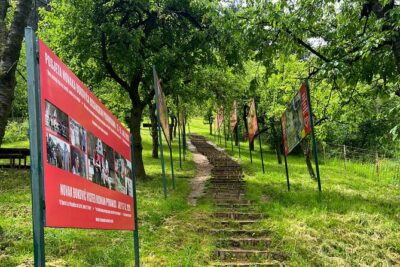 ★ 5.0BOSNIAN PYRAMIDS TOUR (nature, history & archeology)From $7017 reviews
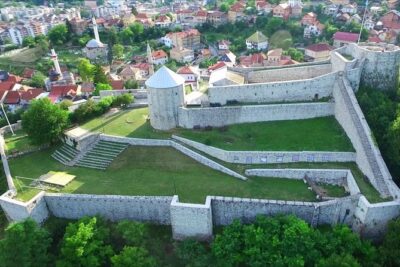 ★ 5.0CENTRAL BOSNIA | A medieval tour (Jajce + Travnik + Pliva lakes)From $9011 reviews
Browse the lists this tour appears in